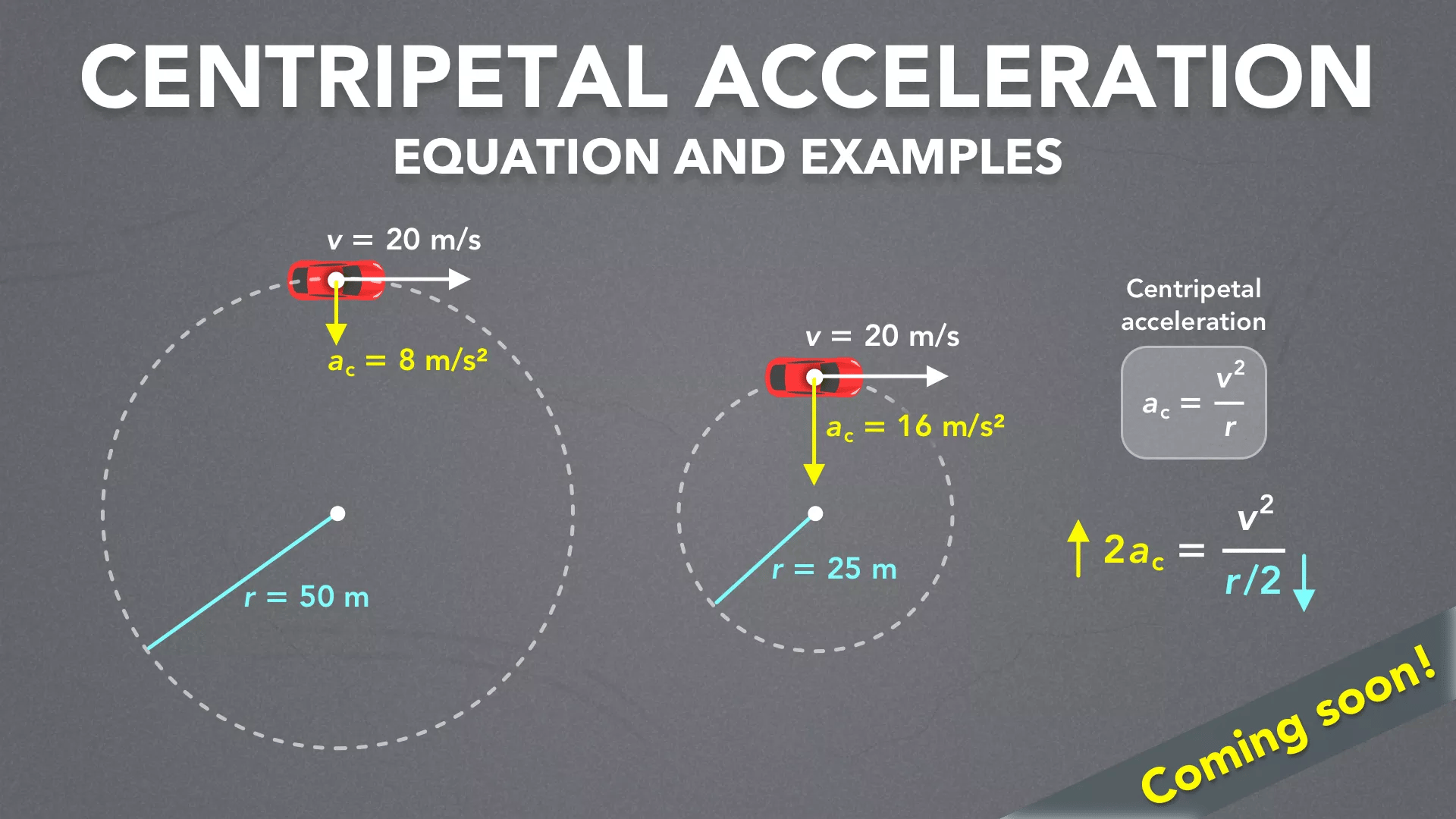
Have you ever been in a car going around a turn and feel like you're being pushed sideways in your seat? Have you ever been on a roller coaster and felt heavier at some points and weightless at other points? What's going on in these scenarios?
If an object is in uniform circular motion then it's traveling in a circle at a constant speed. Even though the speed is constant, the object is actually accelerating. How can that be? Acceleration is a change in velocity over time. But velocity is a vector, so acceleration could be a change in the magnitude (speed) or the direction. In circular motion the direction of the velocity is always changing, so the object is accelerating. We call this centripetal acceleration.
We'll show how the direction of the centripetal acceleration always points towards the center of the circle using some vector math. And we'll learn how to calculate the magnitude of the centripetal acceleration using the speed and the radius of the circle.
But what causes a centripetal acceleration? We learned from Newton's 2nd law (ΣF=ma) that a net force applied to a mass will cause an acceleration. So a centripetal force is what causes the centripetal acceleration of an object.
It will be important to remember that a centripetal force is not a new type of force. It's just what we call the net force acting on an object which points towards the center of the circular path. The centripetal force could be a tension force, a normal force, a gravitational force, or the net force from multiple forces added together.
You may have heard the term "centrifugal force", is that the same thing? Centrifugal force is the force that seems to be pushing you sideways when you're in a car going around a turn. But it turns out that this is a "fictitious" force that doesn't actually exist. So what are you feeling? There's only a centripetal force pushing you towards the center of the circle, and we'll learn how to explain this effect using Newton's 1st law and the inertia of an object in circular motion.
Multiple-Choice Questions
Answers
Free-Response Questions
Circular motion
Law of gravitation
Lab - Circular Motion
(Pages 31-34)
rubber bands, scale, meterstick, disposable plastic cup, scissors, stopwatch
Holt Physics - Laboratory Experiments
Lab - Circular Motion
(Pages 35-39)
flying toy, meterstick, stopwatch, glass tube, rubber stopper with holes, string, hanging mass
Openstax - College Physics for AP Courses Lab Manual - Student Version
Have you ever been in a car going around a turn and feel like you're being pushed sideways in your seat? Have you ever been on a roller coaster and felt heavier at some points and weightless at other points? What's going on in these scenarios?
If an object is in uniform circular motion then it's traveling in a circle at a constant speed. Even though the speed is constant, the object is actually accelerating. How can that be? Acceleration is a change in velocity over time. But velocity is a vector, so acceleration could be a change in the magnitude (speed) or the direction. In circular motion the direction of the velocity is always changing, so the object is accelerating. We call this centripetal acceleration.
We'll show how the direction of the centripetal acceleration always points towards the center of the circle using some vector math. And we'll learn how to calculate the magnitude of the centripetal acceleration using the speed and the radius of the circle.
But what causes a centripetal acceleration? We learned from Newton's 2nd law (ΣF=ma) that a net force applied to a mass will cause an acceleration. So a centripetal force is what causes the centripetal acceleration of an object.
It will be important to remember that a centripetal force is not a new type of force. It's just what we call the net force acting on an object which points towards the center of the circular path. The centripetal force could be a tension force, a normal force, a gravitational force, or the net force from multiple forces added together.
You may have heard the term "centrifugal force", is that the same thing? Centrifugal force is the force that seems to be pushing you sideways when you're in a car going around a turn. But it turns out that this is a "fictitious" force that doesn't actually exist. So what are you feeling? There's only a centripetal force pushing you towards the center of the circle, and we'll learn how to explain this effect using Newton's 1st law and the inertia of an object in circular motion.
More courses have been added to Physics Lab! Check them out on the home page.
You can find the courses that you signed up for in My Dashboard. You can access your dashboard by clicking "My Dashboard" at the top of the home page or in the left sidebar inside a course if you're logged in.
If you've signed up for a course before, you should receive an email in the next week or two with more details about the recent changes to the website.
If you have any questions, send me an email at chris@physicslab.app or a message on Discord @physicslab (Chris).
You can learn more about the issue here at Teachable Status.