
AP® Physics 1 FRQs
These are the free-response questions (FRQs) from past AP® Physics 1 exams from this College Board page. The Fluids unit questions from AP® Physics 2 exams before 2025 are also included. Scoring guidelines and example student responses are included for each question, and the points for each response are mentioned at the end of the examples (note that not all responses received perfect scores).
Check out the MCQ practice tests page for multiple choice questions and solutions for AP® Physics 1.
FRQs Listed by Topic
FRQs Listed by Year
Experimental design
- 2025 Q3 - - Determine mass of block using a spring scale, forces, tension, torque
- 2024 Q2 - - Masses oscillating on a spring, oscillations/simple harmonic motion, energy, momentum
- 2023 Q2 - - Cart on an incline, kinematics
- 2022 Q3 - - Block hanging from string around wheel, energy, rotational motion
- 2021 Q2 - - Stretching a plastic rod
- 2019 Q3 - - Sphere is launched with a spring plunger, projectile motion, energy
- 2017 Q2 - - Coefficient of friction between block and board, forces, friction
- 2016 Q2 - - Testing collisions for a ball, energy
Kinematics
- 2023 Q2 - - (Experimental design) Cart on an incline, kinematics
- 2022 Q1 - - Pulley system with 2 blocks and a spring, kinematics, forces, energy, work
- 2021 Q1 - - Cyclist on ramp jumps over cars, kinematics, projectile motion, energy, work
- 2019 Q1 - - Plunger pushes block and sphere across surface, kinematics, forces, energy, work, torque, angular momentum
- 2019 Q2 - - Pulley system with 2 blocks, kinematics, forces, FBDs, tension, rotational motion
- 2016 Q3 - - Cart rolls down an incline with bumps, kinematics, energy
Projectile motion
- 2022 Q4 - - Clay and ball collide with blocks, momentum, projectile motion
- 2021 Q1 - - Cyclist on ramp jumps over cars, kinematics, projectile motion, energy, work
- 2019 Q3 - - (Experimental design) Sphere is launched with a spring plunger, projectile motion, energy
- 2017 Q4 - - Blocks launched from a slide on table, projectile motion, energy
- 2015 Q4 - - Projectile motion of two spheres, projectile motion, FBDs
Free body diagrams
- 2024 Q1 - - Block sliding on a track with loops, forces, FBDs, circular motion, energy
- 2024 Q3 - - Beam attached to a wall with a string, forces, FBDs, tension, rotational motion, torque
- 2023 Q3 - - Block and spring rotating about axle, circular motion, centripetal force, FBDs
- 2022 Q2 - - Gravitational force between planet and moons, law of gravitation, FBD's
- 2019 Q2 - - Pulley system with 2 blocks, kinematics, forces, FBDs, tension, rotational motion
- 2018 Q1 - - Spacecraft in circular orbit, circular motion, forces, FBDs, law of gravitation
- 2016 Q1 - - Wheel rolls down an incline, forces, FBDs, energy, friction
- 2015 Q1 - - Pulley system with 2 hanging blocks, forces, FBDs, tension
- 2015 Q4 - - Projectile motion of two spheres, projectile motion, FBDs
Forces
- 2025 Q3 - - (Experimental design) Determine mass of block using a spring scale, forces, tension, torque
- 2025 Q4 - - Swimmer holding block in tank of water, forces, fluids
- 2024 Q1 - - Block sliding on a track with loops, forces, FBDs, circular motion, energy
- 2024 Q3 - - Beam attached to a wall with a string, forces, FBDs, tension, rotational motion, torque
- 2024 Q5 - - Collision of two blocks, momentum, energy, forces
- 2022 Q1 - - Pulley system with 2 blocks and a spring, kinematics, forces, energy, work
- 2019 Q1 - - Plunger pushes block and sphere across surface, kinematics, forces, energy, work, torque, angular momentum
- 2019 Q2 - - Pulley system with 2 blocks, kinematics, forces, FBDs, tension, rotational motion
- 2018 Q1 - - Spacecraft in circular orbit, circular motion, forces, FBDs, law of gravitation
- 2017 Q2 - - (Experimental design) Coefficient of friction between block and board, forces, friction
- 2016 Q1 - - Wheel rolls down an incline, forces, FBDs, energy, friction
- 2015 Q1 - - Pulley system with 2 hanging blocks, forces, FBDs, tension
Law of gravitation
- 2024 Q4 - - Pendulum on different planets, law of gravitation, oscillations/simple harmonic motion, work, spring force
- 2022 Q2 - - Gravitational force between planet and moons, law of gravitation, FBD's
- 2018 Q1 - - Spacecraft in circular orbit, circular motion, forces, FBDs, law of gravitation
Friction
- 2017 Q2 - - (Experimental design) Coefficient of friction between block and board, forces, friction
- 2016 Q1 - - Wheel rolls down an incline, forces, FBDs, energy, friction
- 2015 Q3 - - Block-spring system sliding on surface, energy, work, friction
Springs
- 2024 Q2 - - (Experimental design) Masses oscillating on a spring, oscillations/simple harmonic motion, energy, momentum
- 2024 Q4 - - Pendulum on different planets, law of gravitation, oscillations/simple harmonic motion, work, spring force
- 2023 Q1 - - Cart oscillating on horizontal spring, oscillations/simple harmonic motion, energy, work
- 2023 Q3 - - Block and spring rotating about axle, circular motion, centripetal force, FBDs
- 2022 Q1 - - Pulley system with 2 blocks and a spring, kinematics, forces, energy, work
- 2022 Q5 - - Mass oscillating on a vertical spring, oscillations/simple harmonic motion, energy, work
- 2019 Q3 - - (Experimental design) Sphere is launched with a spring plunger, projectile motion, energy
- 2015 Q3 - - Block-spring system sliding on surface, energy, work, friction
Tension
- 2025 Q3 - - (Experimental design) Determine mass of block using a spring scale, forces, tension, torque
- 2024 Q3 - - Beam attached to a wall with a string, forces, FBDs, tension, rotational motion, torque
- 2022 Q1 - - Pulley system with 2 blocks and a spring, kinematics, forces, energy, work
- 2022 Q3 - - (Experimental design) Block hanging from string around wheel, energy, rotational motion
- 2021 Q5 - - 2 blocks hanging from strings on pulleys, rotational motion, torque
- 2019 Q2 - - Pulley system with 2 blocks, kinematics, forces, FBDs, tension, rotational motion
- 2015 Q1 - - Pulley system with 2 hanging blocks, forces, FBDs, tension
Circular motion
- 2024 Q1 - - Block sliding on a track with loops, forces, FBDs, circular motion, energy
- 2023 Q3 - - Block and spring rotating about axle, circular motion, centripetal force, FBDs
- 2018 Q1 - - Spacecraft in circular orbit, circular motion, forces, FBDs, law of gravitation
Energy
- 2025 Q1 - - Block is dropped on a moving cart, energy, momentum
- 2025 Q2 - - Block and spring on an incline, energy
- 2024 Q1 - - Block sliding on a track with loops, forces, FBDs, circular motion, energy
- 2024 Q2 - - (Experimental design) Masses oscillating on a spring, oscillations/simple harmonic motion, energy, momentum
- 2024 Q5 - - Collision of two blocks, momentum, energy, forces
- 2023 Q1 - - Cart oscillating on horizontal spring, oscillations/simple harmonic motion, energy, work
- 2023 Q4 - - Block hanging from string around pulley, rotational motion, torque, angular momentum, energy, work
- 2023 Q5 - - Sphere and rod rotating about axle, rotational motion, torque, energy, work
- 2022 Q1 - - Pulley system with 2 blocks and a spring, kinematics, forces, energy, work
- 2022 Q3 - - (Experimental design) Block hanging from string around wheel, energy, rotational motion
- 2022 Q5 - - Mass oscillating on a vertical spring, oscillations/simple harmonic motion, energy, work
- 2021 Q1 - - Cyclist on ramp jumps over cars, kinematics, projectile motion, energy, work
- 2021 Q4 - - Cylinder rolls and block slides down an incline, energy, work, rotational motion
- 2019 Q1 - - Plunger pushes block and sphere across surface, kinematics, forces, energy, work, torque, angular momentum
- 2019 Q3 - - (Experimental design) Sphere is launched with a spring plunger, projectile motion, energy
- 2018 Q5 - - Block dropped on another oscillating block, energy, momentum, oscillations/simple harmonic motion
- 2017 Q4 - - Blocks launched from slides on tables, projectile motion, energy
- 2016 Q1 - - Wheel rolls down an incline, forces, FBDs, energy, friction
- 2016 Q2 - - (Experimental design) Testing collisions for a ball, energy
- 2016 Q3 - - Cart rolls down an incline with bumps, kinematics, energy
- 2015 Q3 - - Block-spring system sliding on surface, energy, work, friction
Work
- 2024 Q4 - - Pendulum on different planets, law of gravitation, oscillations/simple harmonic motion, work, spring force
- 2023 Q1 - - Cart oscillating on horizontal spring, oscillations/simple harmonic motion, energy, work
- 2023 Q4 - - Block hanging from string around pulley, rotational motion, torque, angular momentum, energy, work
- 2023 Q5 - - Sphere and rod rotating about axle, rotational motion, torque, energy, work
- 2022 Q1 - - Pulley system with 2 blocks and a spring, kinematics, forces, energy, work
- 2022 Q5 - - Mass oscillating on a vertical spring, oscillations/simple harmonic motion, energy, work
- 2021 Q1 - - Cyclist on ramp jumps over cars, kinematics, projectile motion, energy, work
- 2021 Q4 - - Cylinder rolls and block slides down an incline, energy, work, rotational motion
- 2019 Q1 - - Plunger pushes block and sphere across surface, kinematics, forces, energy, work, torque, angular momentum
- 2015 Q3 - - Block-spring system sliding on surface, energy, work, friction
Momentum
- 2025 Q1 - - Block is dropped on a moving cart, energy, momentum
- 2024 Q2 - - (Experimental design) Masses oscillating on a spring, oscillations/simple harmonic motion, energy, momentum
- 2024 Q5 - - Collision of two blocks, momentum, energy, forces
- 2022 Q4 - - Clay and ball collide with blocks, momentum, projectile motion
- 2021 Q3 - - Student pushes disk which hits a block, momentum
- 2018 Q5 - - Block dropped on another oscillating block, energy, momentum, oscillations/simple harmonic motion
Rotational motion
- 2024 Q3 - - Beam attached to a wall with a string, forces, FBDs, tension, rotational motion, torque
- 2023 Q4 - - Block hanging from string around pulley, rotational motion, torque, angular momentum, energy, work
- 2023 Q5 - - Sphere and rod rotating about axle, rotational motion, torque, energy, work
- 2022 Q3 - - (Experimental design) Block hanging from string around wheel, energy, rotational motion
- 2021 Q4 - - Cylinder rolls and block slides down an incline, energy, work, rotational motion
- 2021 Q5 - - 2 blocks hanging from strings on pulleys, rotational motion, torque
- 2019 Q2 - - Pulley system with 2 blocks, kinematics, forces, FBDs, tension, rotational motion
- 2018 Q3 - - Disk spinning on axle, rotational motion, torque
- 2017 Q3 - - Disk collides with pivoting rod, rotational motion, torque, angular momentum
Torque
- 2025 Q3 - - (Experimental design) Determine mass of block using a spring scale, forces, tension, torque
- 2024 Q3 - - Beam attached to a wall with a string, forces, FBDs, tension, rotational motion, torque
- 2023 Q4 - - Block hanging from string around pulley, rotational motion, torque, angular momentum, energy, work
- 2023 Q5 - - Sphere and rod rotating about axle, rotational motion, torque, energy, work
- 2021 Q5 - - 2 blocks hanging from strings on pulleys, rotational motion, torque
- 2019 Q1 - - Plunger pushes block and sphere across surface, kinematics, forces, energy, work, torque, angular momentum
- 2018 Q3 - - Disk spinning on axle, rotational motion, torque
- 2017 Q3 - - Disk collides with pivoting rod, rotational motion, torque, angular momentum
Angular momentum
- 2023 Q4 - - Block hanging from string around pulley, rotational motion, torque, angular momentum, energy, work
- 2019 Q1 - - Plunger pushes block and sphere across surface, kinematics, forces, energy, work, torque, angular momentum
- 2017 Q3 - - Disk collides with pivoting rod, rotational motion, torque, angular momentum
Oscillations / simple harmonic motion
- 2024 Q2 - - (Experimental design) Masses oscillating on a spring, oscillations/simple harmonic motion, energy, momentum
- 2024 Q4 - - Pendulum on different planets, law of gravitation, oscillations/simple harmonic motion, work, spring force
- 2023 Q1 - - Cart oscillating on horizontal spring, oscillations/simple harmonic motion, energy, work
- 2022 Q5 - - Mass oscillating on a vertical spring, oscillations/simple harmonic motion, energy, work
- 2018 Q5 - - Block dropped on another oscillating block, energy, momentum, oscillations/simple harmonic motion
Fluids
The fluids questions from AP Physics 2 before 2025 are also included. Only parts of those questions may be relevant to AP Physics 1 as noted below.
- 2025 Q4 - - Swimmer holding block in tank of water, forces, fluids
- 2023 Q3 - - Tank of water with pipe and two blocks, fluids, forces, buoyant force, flow, Bernoulli's equation, continuity equation
- 2022 Q1 - - (Part a) Block in tank of water hanging from string, fluids, forces, FBDs, buoyant force
- 2021 Q2 - - (Parts b and c) Balloon held underwater, fluids, density, pressure, forces, buoyant force
- 2019 Q4 - - (parts b and ci) Air bubble rises in water, fluids, pressure, forces, buoyant force, energy, work
- 2018 Q4 - - (Parts a and c) Boat carrying steel bars, fluids, forces, buoyant force, flow, continuity equation
- 2017 Q1 - - Water flowing through pipe, fluids, flow, continuity equation, Bernoulli's equation, conservation of energy, forces, FBDs, buoyant force
2025 Free-Response Questions Answers & scoring guidelines
- Q1 - - Block is dropped on a moving cart, energy, momentum
- Q2 - - Block and spring on an incline, energy
- Q3 - - (Experimental design) Determine mass of block using a spring scale, forces, tension, torque
- Q4 - - Swimmer holding block in tank of water, forces, fluids
2024 Free-Response Questions Answers & scoring guidelines
- Q1 - - Block sliding on a track with loops, forces, FBDs, circular motion, energy
- Q2 - - (Experimental design) Masses oscillating on a spring, oscillations/simple harmonic motion, energy, momentum
- Q3 - - Beam attached to a wall with a string, forces, FBDs, tension, rotational motion, torque
- Q4 - - Pendulum on different planets, law of gravitation, oscillations/simple harmonic motion, work, spring force
- Q5 - - Collision of two blocks, momentum, energy, forces
2023 Free-Response Questions Answers & scoring guidelines
- Q1 - - Cart oscillating on horizontal spring, oscillations/simple harmonic motion, energy, work
- Q2 - - (Experimental design) Cart on an incline, kinematics
- Q3 - - Block and spring rotating about axle, circular motion, centripetal force, FBDs
- Q4 - - Block hanging from string around pulley, rotational motion, torque, angular momentum, energy, work
- Q5 - - Sphere and rod rotating about axle, rotational motion, torque, energy, work
- AP Physics 2 - Q3 - - Tank of water with pipe and two blocks, fluids, forces, buoyant force, flow, Bernoulli's equation, continuity equation
2022 Free-Response Questions Answers & scoring guidelines
- Q1 - - Pulley system with 2 blocks and a spring, kinematics, forces, energy, work
- Q2 - - Gravitational force between planet and moons, law of gravitation, FBDs
- Q3 - - (Experimental design) Block hanging from string around wheel, energy, rotational motion
- Q4 - - Clay and ball collide with blocks, momentum, projectile motion
- Q5 - - Mass oscillating on a vertical spring, oscillations/simple harmonic motion, energy, work
- AP Physics 2 - Q1 - - (Part a) Block in tank of water hanging from string, fluids, forces, FBDs, buoyant force
2021 Free-Response Questions Answers & scoring guidelines
- Q1 - - Cyclist on ramp jumps over cars, kinematics, projectile motion, energy, work
- Q2 - - (Experimental design) Stretching a plastic rod
- Q3 - - Student pushes disk which hits a block, momentum
- Q4 - - Cylinder rolls and block slides down an incline, energy, work, rotational motion
- Q5 - - 2 blocks hanging from strings on pulleys, rotational motion, torque
- AP Physics 2 - Q2 - - (Parts b and c) Balloon held underwater, fluids, density, pressure, forces, buoyant force
2019 Free-Response Questions Answers & scoring guidelines
- Q1 - - Plunger pushes block and sphere across surface, kinematics, forces, energy, work, torque, angular momentum
- Q2 - - Pulley system with 2 blocks, kinematics, forces, FBDs, tension, rotational motion
- Q3 - - (Experimental design) Sphere is launched with a spring plunger, projectile motion, energy
- Q4 - (now AP Physics 2 material)
- Q5 - (now AP Physics 2 material)
- AP Physics 2 - Q4 - - (parts b and ci) Air bubble rises in water, fluids, pressure, forces, buoyant force, energy, work
2018 Free-Response Questions Answers & scoring guidelines
- Q1 - - Spacecraft in circular orbit, circular motion, forces, FBDs, law of gravitation
- Q2 - (now AP Physics 2 material)
- Q3 - - Disk spinning on axle, rotational motion, torque
- Q4 - (now AP Physics 2 material)
- Q5 - Block dropped on another oscillating block, energy, momentum, oscillations/simple harmonic motion
- AP Physics 2 - Q4 - - (Parts a and c) Boat carrying steel bars, fluids, forces, buoyant force, flow, continuity equation
2017 Free-Response Questions Answers & scoring guidelines
- Q1 - (now AP Physics 2 material)
- Q2 - - (Experimental design) Coefficient of friction between block and board, forces, friction
- Q3 - - Disk collides with pivoting rod, rotational motion, torque, angular momentum
- Q4 - - Blocks launched from slides on tables, projectile motion, energy
- Q5 - (now AP Physics 2 material)
- AP Physics 2 - Q1 - - Water flowing through pipe, fluids, flow, continuity equation, Bernoulli's equation, conservation of energy, forces, FBDs, buoyant force
These are the four types of FRQs in the order that they will appear on the 2026 AP Physics 1 exam. This is from page 180 in the AP Physics 1 Course and Exam Description.
10 points; suggested time: 20-25 minutes
The Mathematical Routines (MR) question assesses students’ ability to use mathematics to analyze a scenario and make predictions about that scenario. Students will be expected to symbolically derive relationships between variables, as well as calculate numerical values. Students will be expected to create and use representations that describe the scenario, either to help guide the mathematical analysis (such as drawing a free-body diagram) or that are applicable to the scenario (such as sketching velocity as a function of time).
For AP Physics 1 and AP Physics 2, the MR question will ask students to make a claim or prediction about the scenario and use appropriate physics concepts and principles to support and justify that claim. The justification is expected to be a logical and sequential application of physics concepts that demonstrates a student’s ability to connect multiple concepts to each other.
12 points; suggested time: 25-30 minutes
The Translation Between Representations (TBR) question assesses students’ ability to connect different representations of a scenario. Students will be expected to create a visual representation that describes a given scenario. Students will derive equations that are mathematically relevant to the scenario. Students will draw graphs that relate quantities within the scenario. Finally, students will be asked to do any one of the following:
- Justify why their answers to any two of the previous parts do/do not agree with each other.
- Use their representations, mathematical analysis, or graph to make a prediction about another situation and justify their prediction using that reasoning or analysis.
- Use their representations, mathematical analysis, or graph to make a prediction about how those representations would change if properties of the scenario were altered and justify that claim using consistent reasoning or analysis.
10 points; suggested time: 25-30 minutes
The Experimental Design and Analysis (LAB) question assesses students’ ability to create scientific procedures that can be used with appropriate data analysis techniques to determine the answer to given questions. The LAB question can roughly be divided into two sections: Design and Analysis. In the Design portion of the LAB question, students will be asked to develop a method by which a question about a given physical scenario could be answered. The experimental procedure is expected to be scientifically sound: vary a single parameter, and measure how that change affects a single characteristic. Methods must be able to be performed in a typical high school laboratory. Measurements must be made with realistically obtainable equipment or sensors. Students will be expected to describe a method by which the collected data could be analyzed in order to answer the posed question, by either graphical or comparative analyses.
Students will then be given experimental data collected in order to answer a similar, but not identical, question to what was asked in the Design portion of the question. Students will be asked to use the data provided to create and plot a graph that can be analyzed to determine the answer to the given question. For instance, the slope or intercepts of the line may be used to determine a physical quantity or perhaps the nature of the slope would answer the posed question.
8 points; suggested time: 15-20 minutes
The Qualitative/Quantitative Translation (QQT) question assesses students’ ability to connect the nature of the scenario, the physical laws that govern the scenario, and mathematical representations of that scenario to each other. Students will be asked to make and justify a claim about a given scenario, as well as derive an equation related to that scenario. Finally, students will be asked to do any one of the following:
- Justify why their answers to any of the previous parts do/do not agree with each other.
- Use their representations or mathematical analysis to make a prediction about another situation and justify their prediction using that reasoning or analysis.
- Use their representations and mathematical analysis to make a prediction about how those representations would change if properties of the scenario were altered and justify that claim using consistent reasoning or analysis.
While students may not be directly assessed on their ability to create diagrams or other representations of the system to answer the QQT, those skills may still help students to answer the QQT. For instance, some students may find that drawing a free-body diagram is useful when determining the acceleration of a system. However, the student will earn points for the explanation and conclusions that diagram indicates (or perhaps the derivation that results from the diagram), rather than for creating the diagram itself.
Here are some videos and playlists that cover AP Physics 1 FRQs:
- 9 Must Know FRQs for AP Physics 1 - The Physics Universe
- AP Physics 1 FRQs - Allen Tsao The STEM Coach
- AP Physics 1 Exam Review - Allen Tsao The STEM Coach
- AP Physics 1: AP Classroom Progress Checks FRQs - Mr. Heinrich
- AP Physics 1 FRQ Solutions - Flipping Physics
- Experimental Design Questions Explained - Flipping Physics
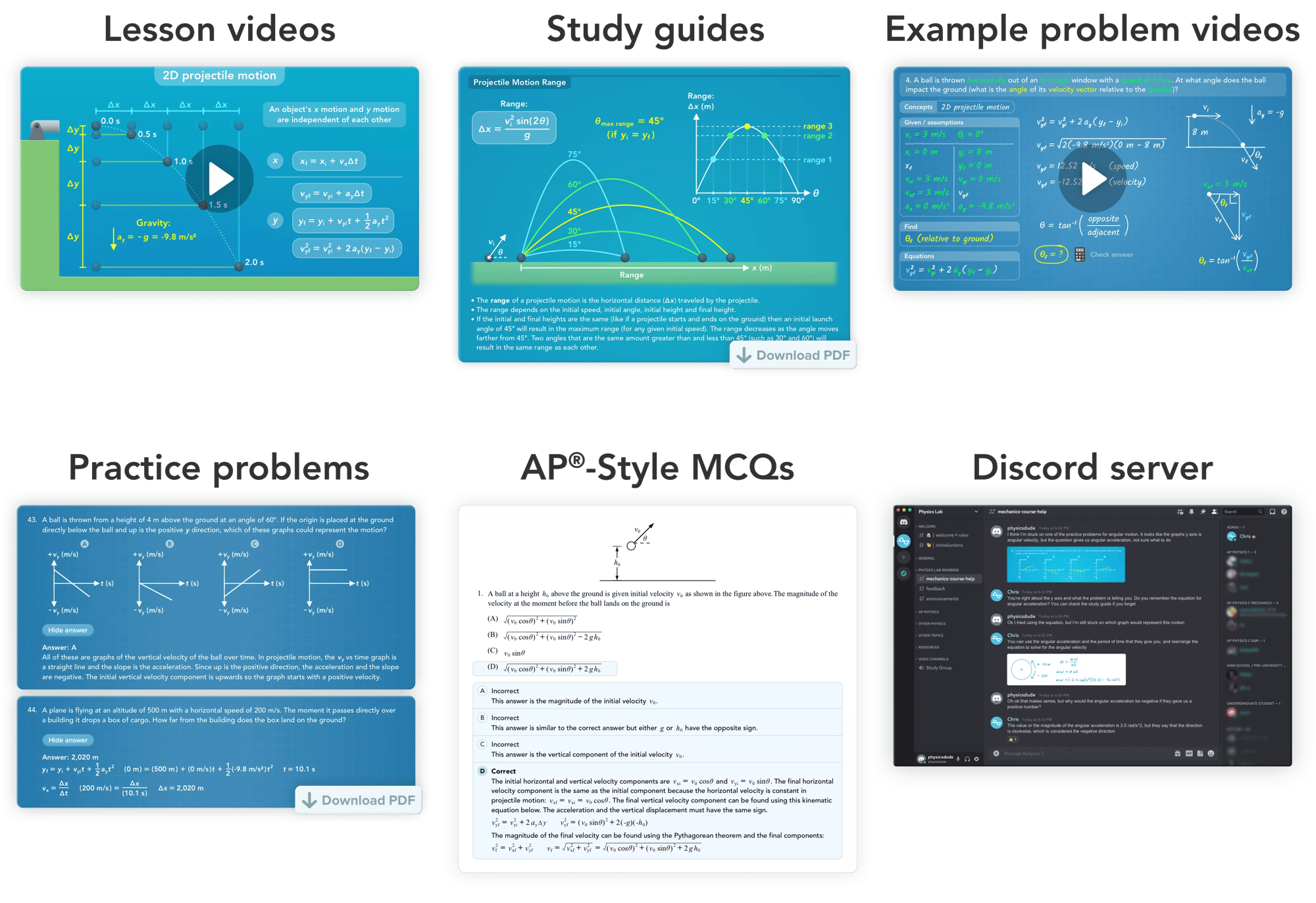
More courses have been added to Physics Lab! Check them out on the home page.
You can find the courses that you signed up for in My Dashboard. You can access your dashboard by clicking "My Dashboard" at the top of the home page or in the left sidebar inside a course if you're logged in.
If you've signed up for a course before, you should receive an email in the next week or two with more details about the recent changes to the website.
If you have any questions, send me an email at chris@physicslab.app or a message on Discord @physicslab (Chris).
You can learn more about the issue here at Teachable Status.